
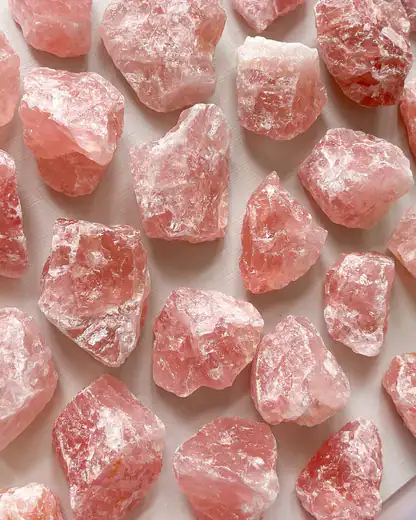
Rose Quartz Freeform

Price range: $8.00 through $33.00

Rose Quartz - Pink Variety of Quartz Rose Quartz is a pink variety of quartz (SiO₂) known for its soft, rosy hue that ranges from very pale pink to medium-dark pink. It is one of the most popular varieties of quartz used in jewelry and decorative objects. What Causes the Pink Color: The pink color of rose quartz has been attributed to trace amounts of titanium, iron, or manganese within the crystal structure. Some specimens contain microscopic fibrous inclusions of a pink borosilicate mineral similar to dumortierite, which contribute to the color. The exact cause can vary between specimens. Physical Properties: Chemical Formula: SiO₂ (silicon dioxide) Crystal System: Trigonal Hardness: 7 on the Mohs scale (good scratch resistance) Luster: Vitreous (glass-like) Specific Gravity: Approximately 2.65 Transparency: Translucent to opaque Formation & Occurrence: Rose quartz typically forms in pegmatites and is found in massive form rather than as well-formed crystals. Major sources include Brazil, Madagascar, South Africa, India, and the United States (South Dakota). Historical Use: Rose quartz has been used in jewelry and as a decorative stone since ancient times. Beads dating back to 7000 BC have been found in Mesopotamia (present-day Iraq). Care: Rose quartz is relatively durable but can fade with prolonged exposure to direct sunlight. Clean with mild soap and water. Images shown are examples only—each crystal is unique and your stone will vary in color, pattern, and formation. Shipping will be calculated at checkout. Sources: Wikipedia, Britannica

Product and photo may differ. We curate each item with care, and actual contents may vary based on availability and intuitive selection.

Rose Quartz – Pink Variety of Quartz

Rose Quartz is a pink variety of quartz (SiO₂) known for its soft, rosy hue that ranges from very pale pink to medium-dark pink. It is one of the most popular varieties of quartz used in jewelry and decorative objects.

What Causes the Pink Color:
The pink color of rose quartz has been attributed to trace amounts of titanium, iron, or manganese within the crystal structure. Some specimens contain microscopic fibrous inclusions of a pink borosilicate mineral similar to dumortierite, which contribute to the color. The exact cause can vary between specimens.

Physical Properties:

  • Chemical Formula: SiO₂ (silicon dioxide)
  • Crystal System: Trigonal
  • Hardness: 7 on the Mohs scale (good scratch resistance)
  • Luster: Vitreous (glass-like)
  • Specific Gravity: Approximately 2.65
  • Transparency: Translucent to opaque

Formation & Occurrence:
Rose quartz typically forms in pegmatites and is found in massive form rather than as well-formed crystals. Major sources include Brazil, Madagascar, South Africa, India, and the United States (South Dakota).

Historical Use:
Rose quartz has been used in jewelry and as a decorative stone since ancient times. Beads dating back to 7000 BC have been found in Mesopotamia (present-day Iraq).

Care:
Rose quartz is relatively durable but can fade with prolonged exposure to direct sunlight. Clean with mild soap and water.

Images shown are examples only—each crystal is unique and your stone will vary in color, pattern, and formation. Shipping will be calculated at checkout. Sources: Wikipedia, Britannica

Size

Large (4-6") – $33, Medium (2-4") – $18, Small (1-2") – $8